The Tank and the Tender
Plant equipment design at Thai Beverage

11
Year — 2021
Categories
Role
- Engineering internship — Thai Beverage PCL
- Summer placement — Chulalongkorn University
- Tank design, tender specification & corrosion review
Before the machine learning, there was steel. A summer inside Thai Beverage’s Office of Mechanical Engineering set three problems a lecture course does not: size a 7,041 m³ molasses tank to API 650 — plate by plate, course by course — draft the tender specification that would let a contractor build a 40-foot container unloader, and trace rust on a fermentation vessel back to its mechanism. The common lesson: a design is not finished until it can be bought, built, and inspected.
Placement
Thai Beverage is the largest drinks producer in Thailand and one of the largest in Southeast Asia — eighteen distilleries and three breweries in the country alone. Its Office of Mechanical Engineering designs the equipment those plants run on: storage vessels, process machinery, and the automated handling systems that move raw material through them.
I sat in the design section, reporting to the office manager and the head of design and site supervision, and was given three briefs: a storage tank to size from first principles, a tender document to write for a plant upgrade in another province, and a corrosion failure to explain. Two plant surveys supplied the context the drawings assumed — a boiler and steam header inspection at United Winery and Distillery in Nakhon Pathom, and the bottling hall at Bang Yi Khan in Pathum Thani, from bottle washer and empty-bottle inspection through filler, capper, and labeller.
The tank
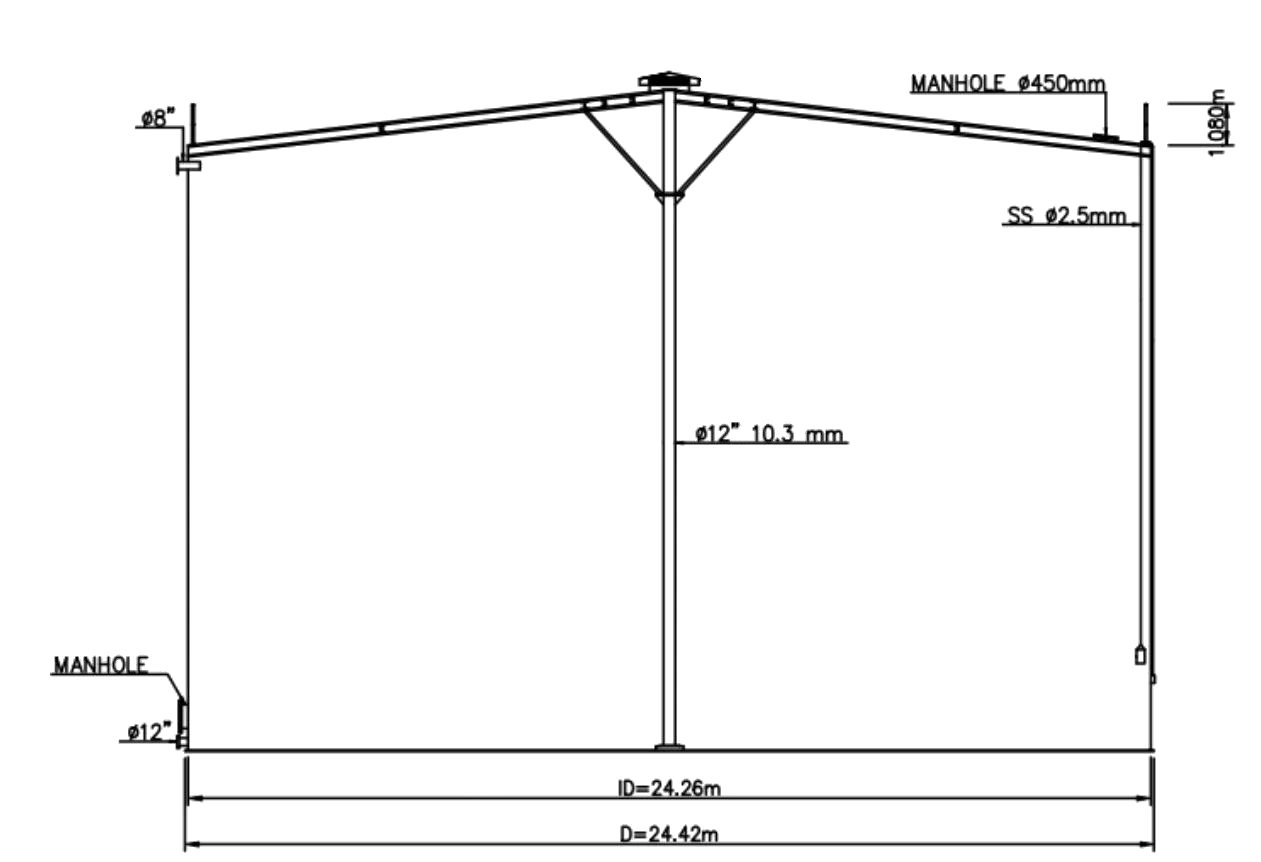
The brief was a vertical cylindrical tank for molasses, sized to match one already standing at the Bang Yi Khan distillery: 24.26 m in diameter, 15.24 m tall, about 7,041 m³. None of the method had been taught in a lecture, so it came out of a pressure-vessel handbook and a senior engineer’s periodic checks of my arithmetic.
The governing standard is API 650, and the governing method is the One-Foot Method: each course of the wall is checked one foot above its own bottom seam, where the hoop stress in that course peaks. Every course therefore earns a different thickness — 4.9·D·(H−0.3)·G ⁄ (S·E), plus a corrosion allowance. Molasses is heavy (specific gravity 1.6), the seam is single-V welded onto a flat-bar backing (joint efficiency 0.7), and SS400 plate is allowed 148 MPa. The base course computes to 29.42 mm and the top to 4.25 mm; the wall steps 30 mm down to 6 mm over ten courses, 250 plates of 1.524 × 3.048 m steel.
Underneath, an annular ring takes the static compressive load of shell, roof, and contents — API 650 ties its thickness to the first course, so it runs 30 mm around a floor that is 10 mm, with the code’s 600 mm weld setback, 65 mm lap, and 50 mm projection designed in. Above, a conical roof at a 1:10 rafter slope rises 1.08 m over a 12.178 m slant, carried on radial WF150 rafters and a single centre column. Every part was drawn in GstarCAD.
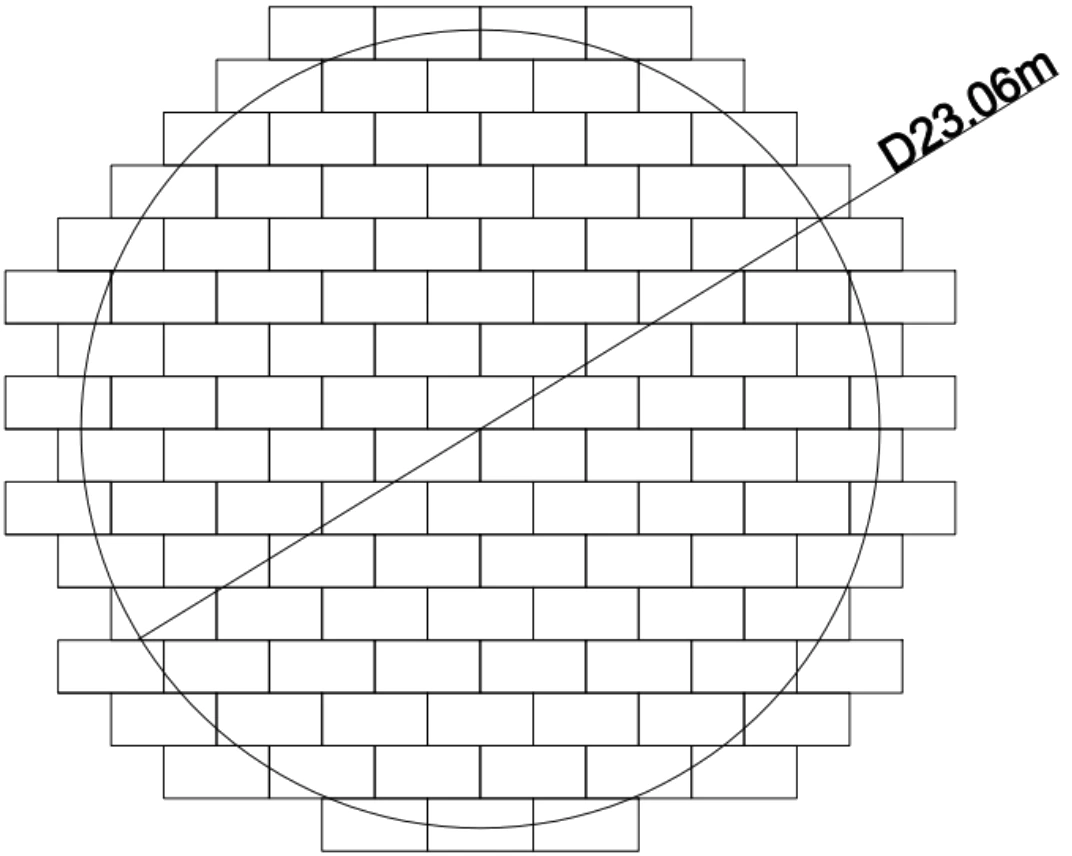
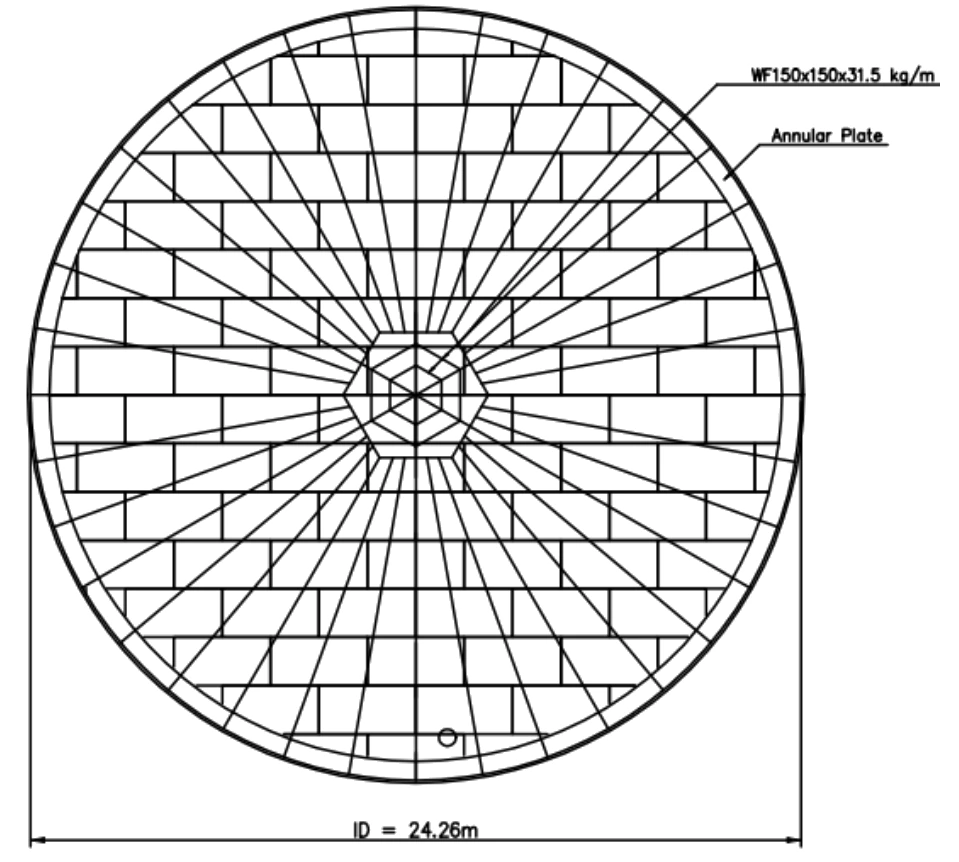
The calculation says 29.42 mm. The mill rolls 30. Every real design ends at the nearest plate you can actually buy.
Specified
- Tank capacity
- 7,041 m³
- Steel plates scheduled
- 481
- Shell courses, each sized
- 10
- Wall, bottom to top
- 30 → 6 mm
- Tender clauses drafted
- 17
- Design standard
- API 650
The tender
At the Red Bull Distillery in Samut Sakhon, malt arrived by truck and left the truck by shovel. The plant had moved from 20-foot containers to 40-foot ones and the existing dumping station could not take them, so the upgrade was to be put out to an outside contractor. Which meant somebody had to write the document that told the contractor exactly what to build — and exactly what “finished” would mean.
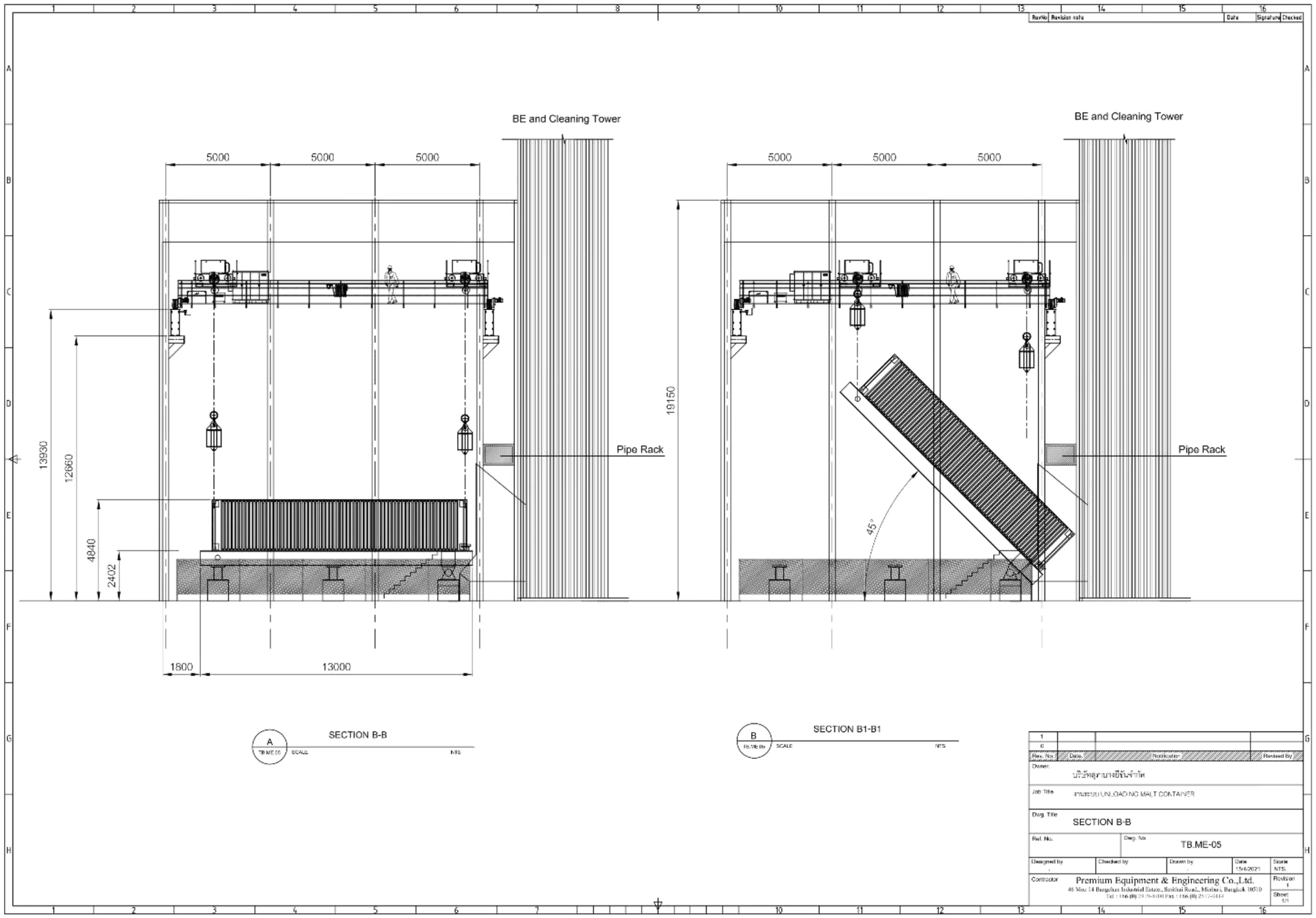
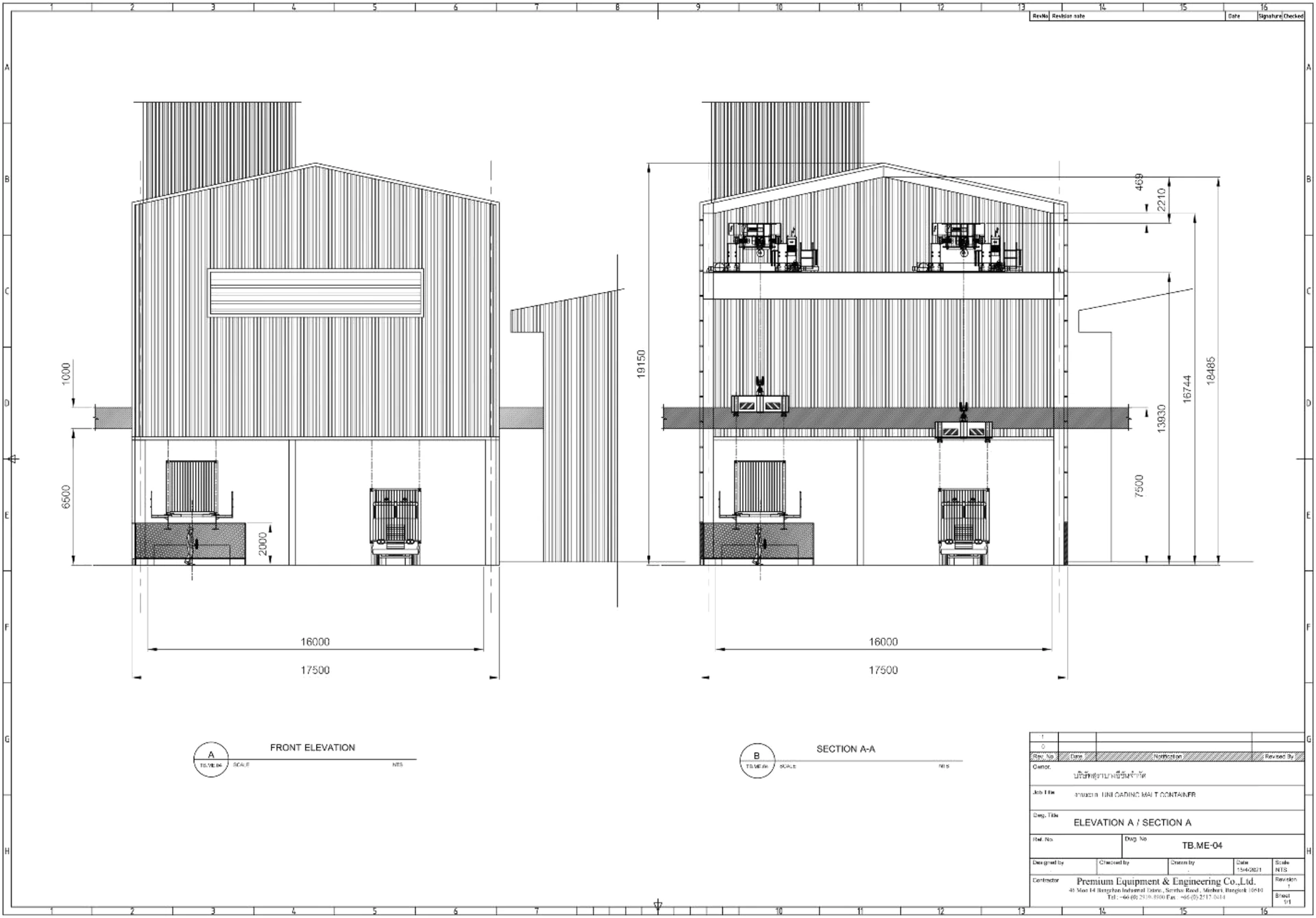
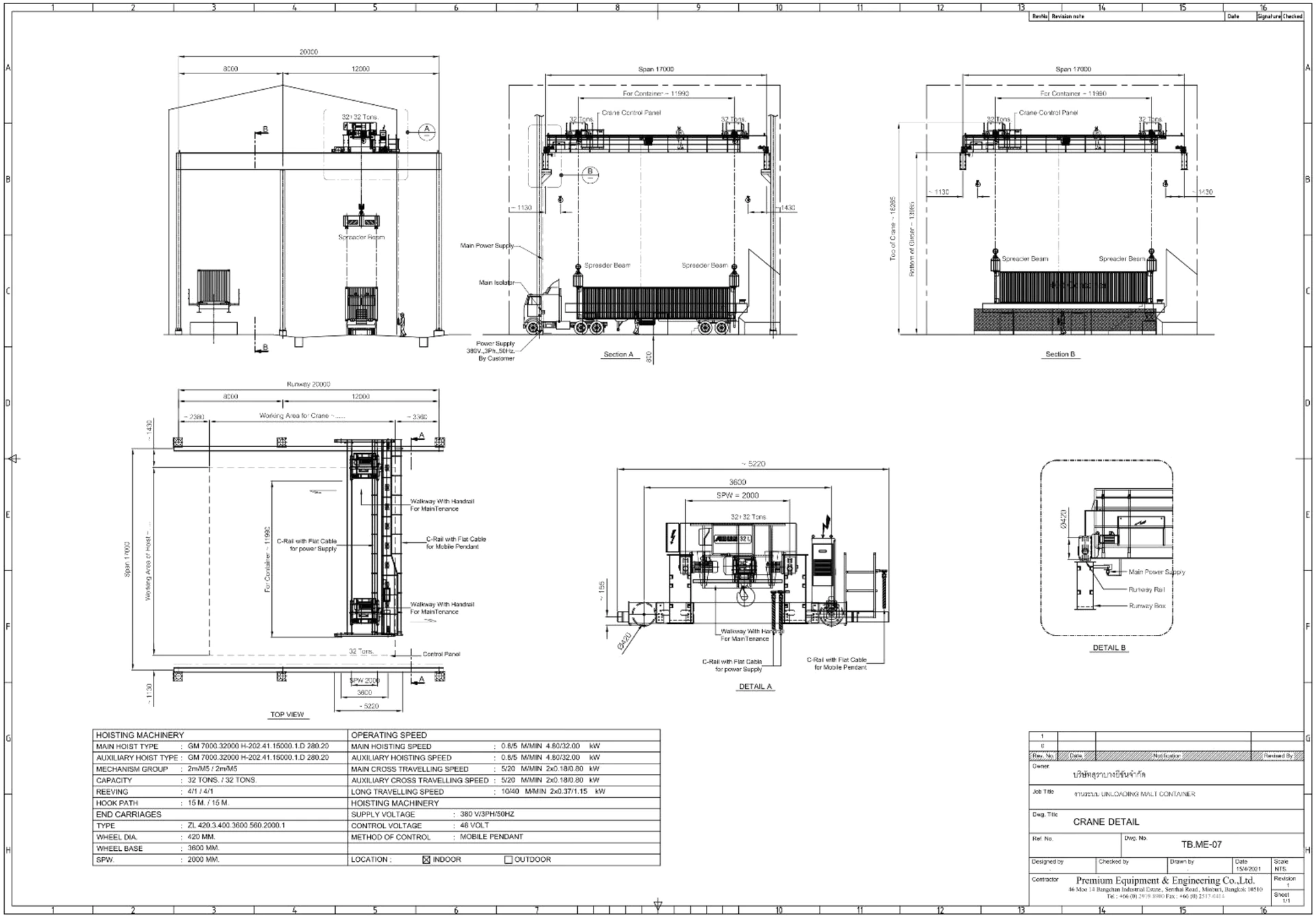
Drafting it meant reading the plant’s floor plans, asking the site team to measure the real bay, and turning a loose intent — unload malt without shovels — into seventeen enforceable clauses. Lift a loaded 40-foot container and tilt it past 45° while positively locked. Wire rope at a safety factor of 5, galvanised, polyamide-cored, self-lubricating. A brake that holds 1.5× the design load and sets itself whenever current is lost. An overload cut-out that permits only lowering. Limit switches against over-travel and against the building itself. Automatic and manual control. Sirens on every direction of travel. And an hour counter — because maintenance is a requirement too, not an afterthought.
The contractor drawings reproduced in the report’s appendix show what those clauses buy: twin 32-tonne hoists on a 17-metre span, spreader beams onto the container’s corner castings, and the whole bay raised so a 40-foot box can swing clear of its own roof.
Failure analysis
The third brief began with rust. Inspection had found corrosion staining on the shell plates and legs of the tanks that hold and chill new liquor starter, and the tanks were to be rebuilt. Before anything could be rebuilt, though, the mechanism had to be named — and it was pitting corrosion: the localised kind that bores pinholes through a wall still sound almost everywhere else, which is why a vessel can fail inspection having lost almost no measurable thickness.
Naming it changed the job. A replacement built the same way would pit the same way, so the new tanks needed a different manufacturing process — and writing that process up, step by step with progress reported every three days, was mine.
Outcome
None of the three briefs could be closed by getting a number right. The tank had to become a plate schedule. The upgrade had to become a document a contractor could be held to. The corrosion had to become a process change. What the placement taught, more than any formula, is that industrial engineering is specification — and that a safety margin is not padding but the difference between a calculation and a structure.
It ended in a presentation to the executive committee and the mechanical and electrical engineering staff, in a room where most people were not engineers: cut the detail, order the content by what the audience needs first, keep to time, rehearse it with your mentor first. The placement also settled what came next — a master’s degree, and the decision every other project on this site descends from.
- Thai Beverage PCL — Office of Mechanical Engineering, Bangkok
Next case study
01 / 11