Sensing Without Sensors
An unknown-input observer for soft robotics

08
Year — 2023
Categories
Role
- First author — IEEE HORA 2023
- Modeling, observer design & simulation
IEEE HORA · 2023
The fingertips of a soft gripper deform in ways no onboard sensor can easily measure — yet that deformation is exactly what determines whether a grasp holds. This work replaced the missing sensor with mathematics: a first-principles model of the entire pneumatic drivetrain, and an unknown-input nonlinear observer that reconstructs the gripper’s hidden states from the one signal available — the motor encoder, four physical stages away.
Problem
The only measurement in the system is the angular position of the DC motor driving the air cylinder — separated from the gripper by a ball screw, a piston, and a column of compressed air. Everything in between is stubbornly nonlinear: pressure coupling governed by Boyle’s law, screw friction, and the elastic response of silicone. The challenge was to recover the gripper’s state accurately enough to control it, without adding a single sensor.
Approach
The missing measurement is treated as an estimation problem, not a hardware problem. The actuation chain is modeled from first principles — the motor’s electrical circuit and rotor dynamics, the ball-screw stage, the cylinder’s piston, and the gripper idealized as a spring-loaded pneumatic piston. That model exposes the gripper’s deformation as an unknown input acting on the measurable part of the system.
Relative-degree analysis proves the unknown input can be reconstructed from the encoder alone; filtered output derivatives recover it algebraically; and a bounded-Jacobian nonlinear observer converges the full state estimate onto the truth — deformation, velocity, and current, all inferred from one encoder.
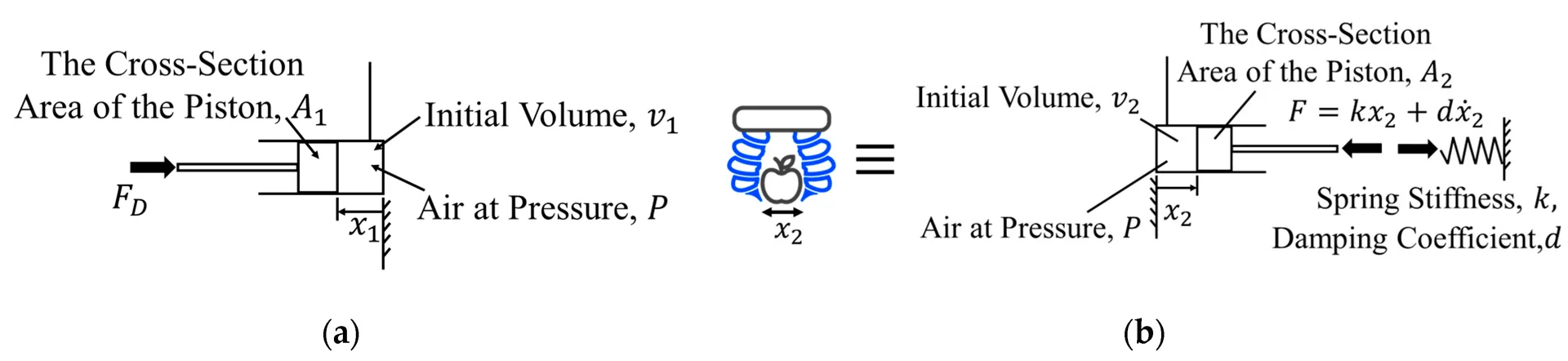
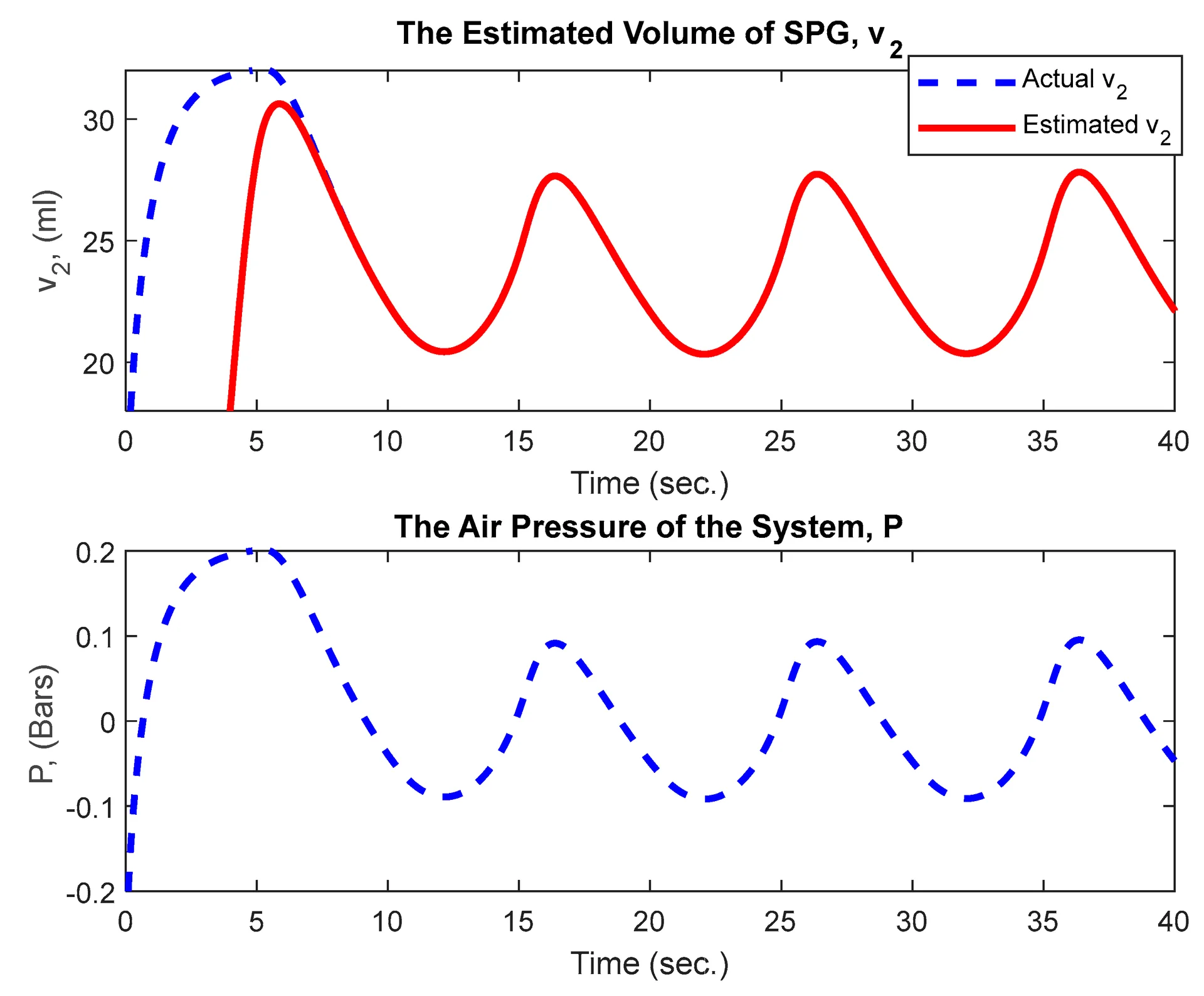
The estimate lives four physical stages away from its measurement — encoder, ball screw, piston, air, silicone — and the observer sees through all of it.
Estimation
- Measured signals
- 1 — motor encoder
- Estimated quantities
- 3 states + unknown input
- Sensors on the gripper
- 0
- Venue
- IEEE HORA 2023
Outcome
Simulation confirmed rapid convergence from incorrect initial guesses to the true values of the unknown input and all internal states. The estimated states became the feedback signal for the published grasping controller — automotive-grade estimation theory, carried to the frontier of soft robotics. Presented at the 5th IEEE International Congress on Human-Computer Interaction, Optimization and Robotic Applications, as first author.
- Chulalongkorn University, Mechanical Engineering
Next case study
09 / 11