The Delicate Grasp
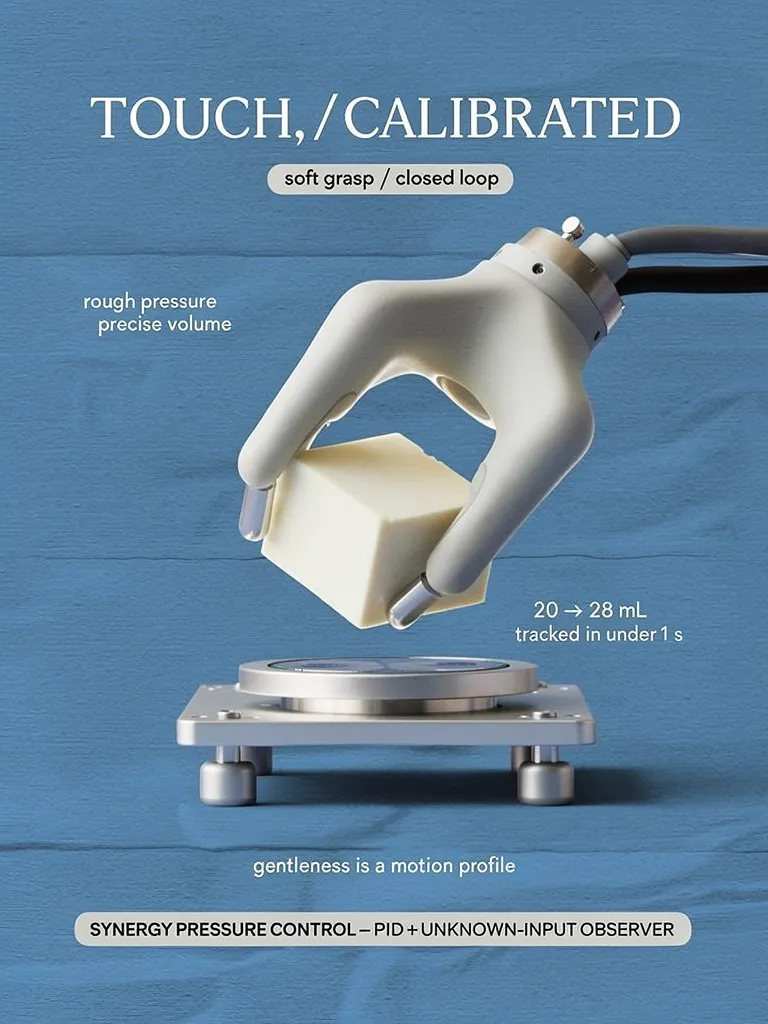
A soft robotic gripper gentle enough for tofu
09
Year — 2022–23
Categories
Role
- BEng thesis — Chulalongkorn University
- Modeling, fabrication & validation
- Published in Robotics (MDPI), 2023
Robotics (MDPI) · 12(4) · 2023
Soft pneumatic grippers are the natural choice for delicate objects — and a control nightmare, because their greatest strength is that they deform. Industry-standard on-off pressure control delivers an abrupt grab that pulverizes a block of tofu. This project paired smarter hardware with smarter estimation: a two-stage pneumatic architecture for fine control, and a virtual sensor that infers the gripper’s internal volume from pure physics.
Problem
Silicone fingers have effectively infinite degrees of freedom and deeply nonlinear behavior. The precise industrial alternative — a screw compressor — is far too expensive for practical deployment. And the one variable that determines grasp quality, the gripper’s internal air volume, cannot be measured by any sensor.
The insight that reframed the problem: delicate objects are damaged by momentum, not just force. The controller must shape the velocity of the grasp, not merely its pressure.
Approach
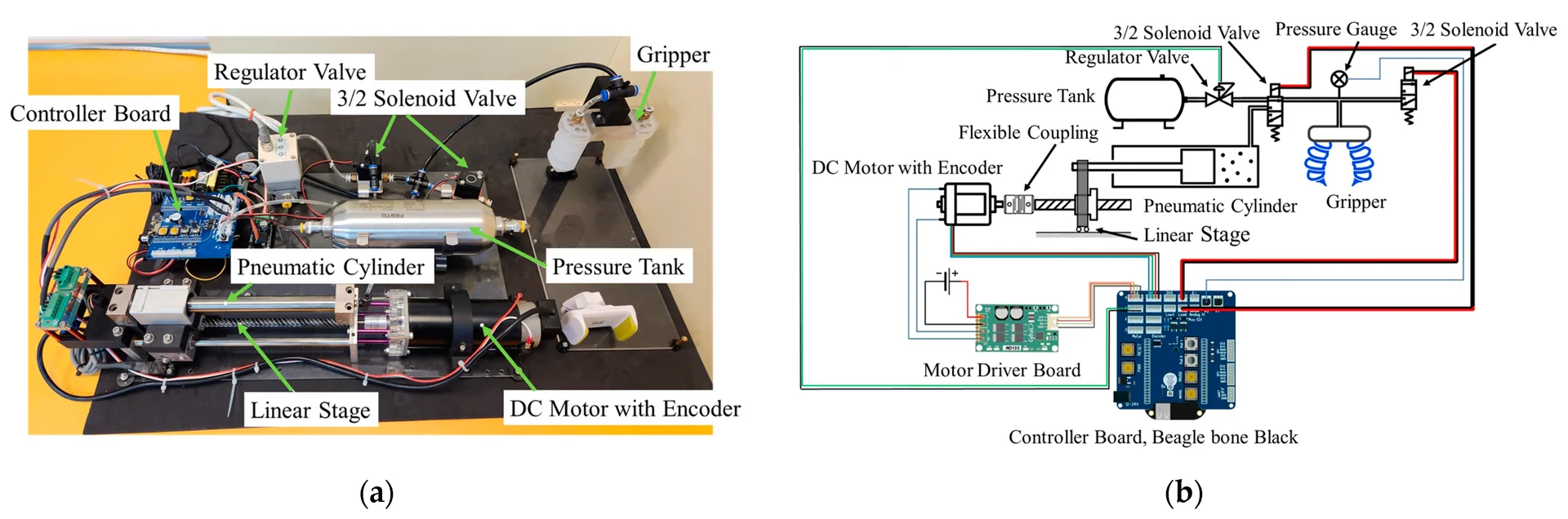
The hardware works like a rough cut followed by a finishing pass: an ordinary compressor with a digital regulator gets pressure roughly right, while a pneumatic cylinder driven by a ball-screw stage and DC servo fine-tunes pressure and volume through precise linear motion.
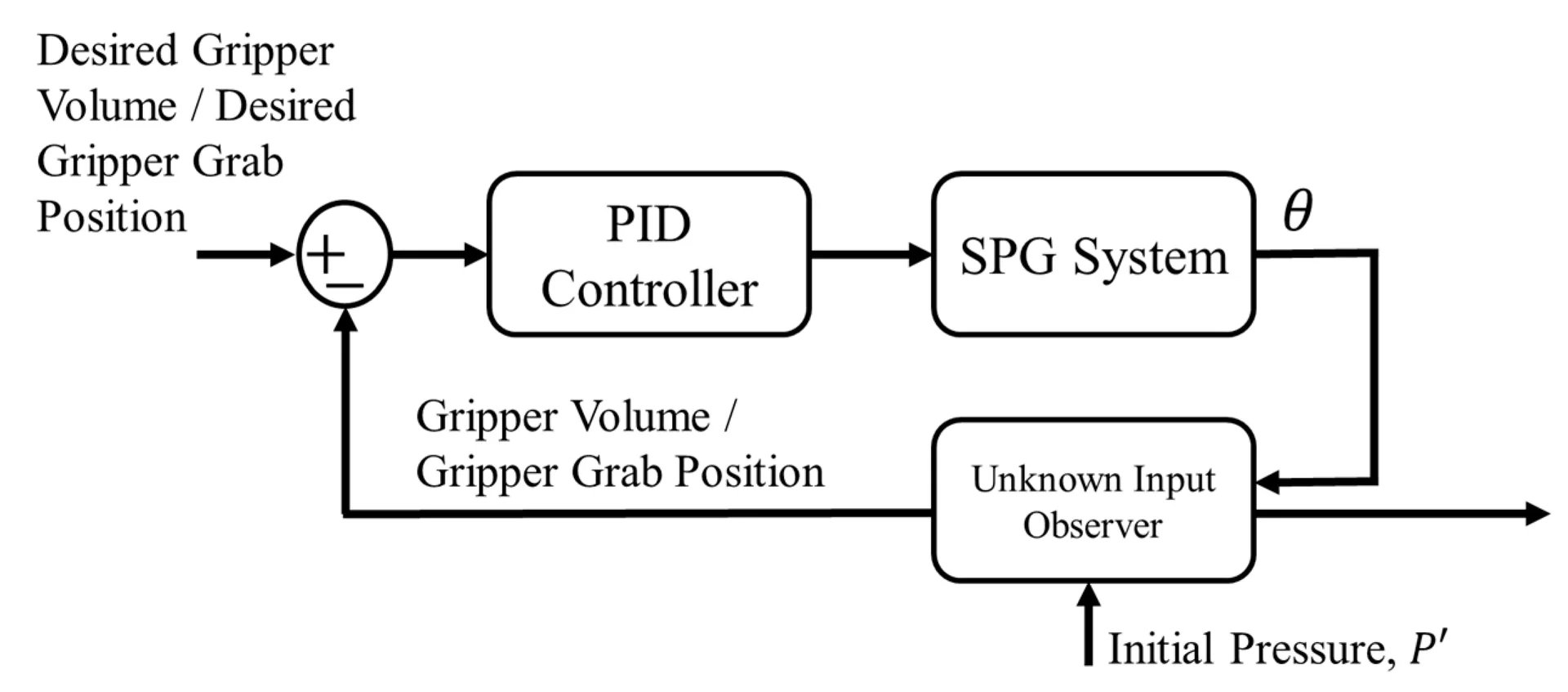
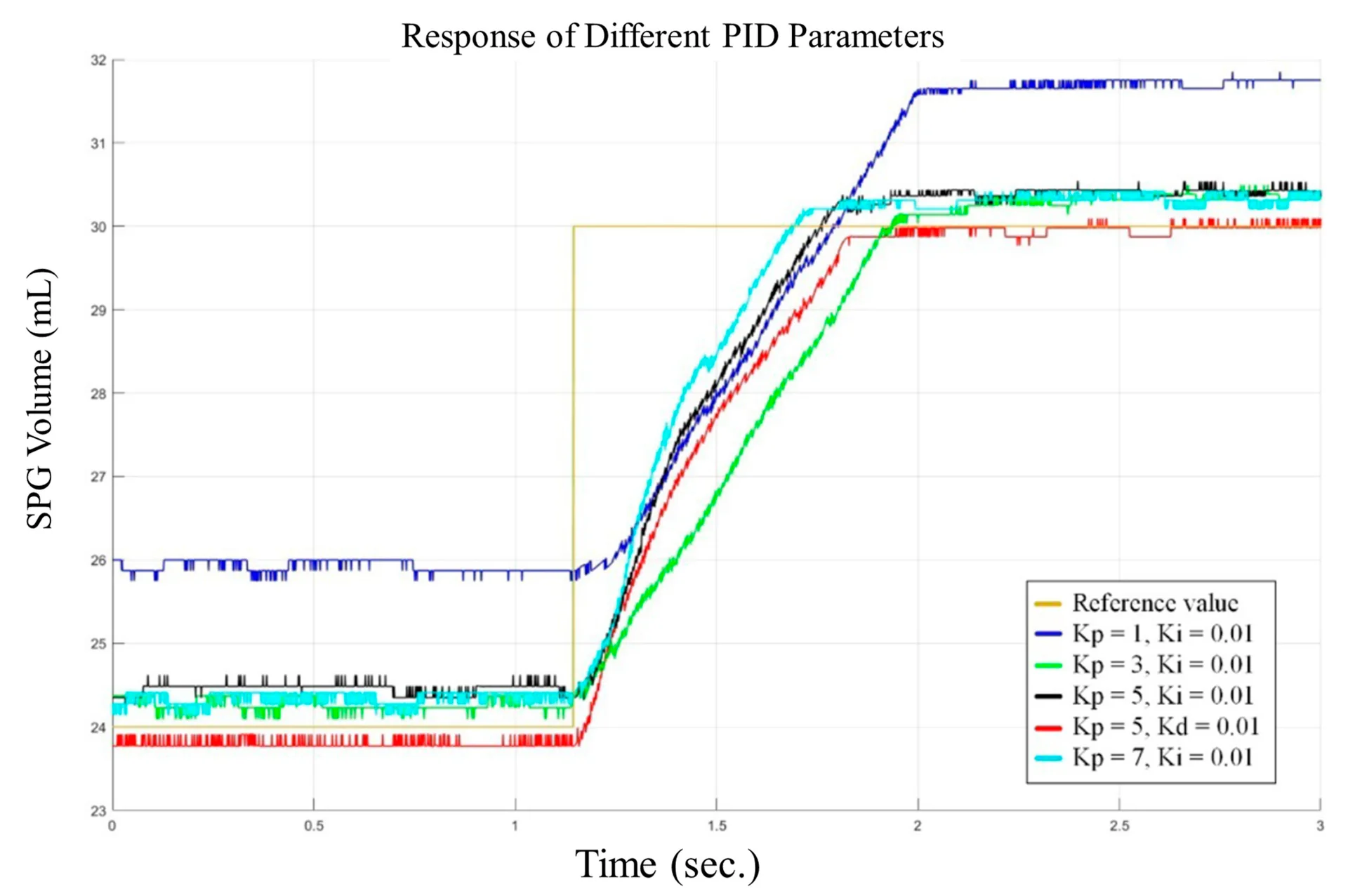
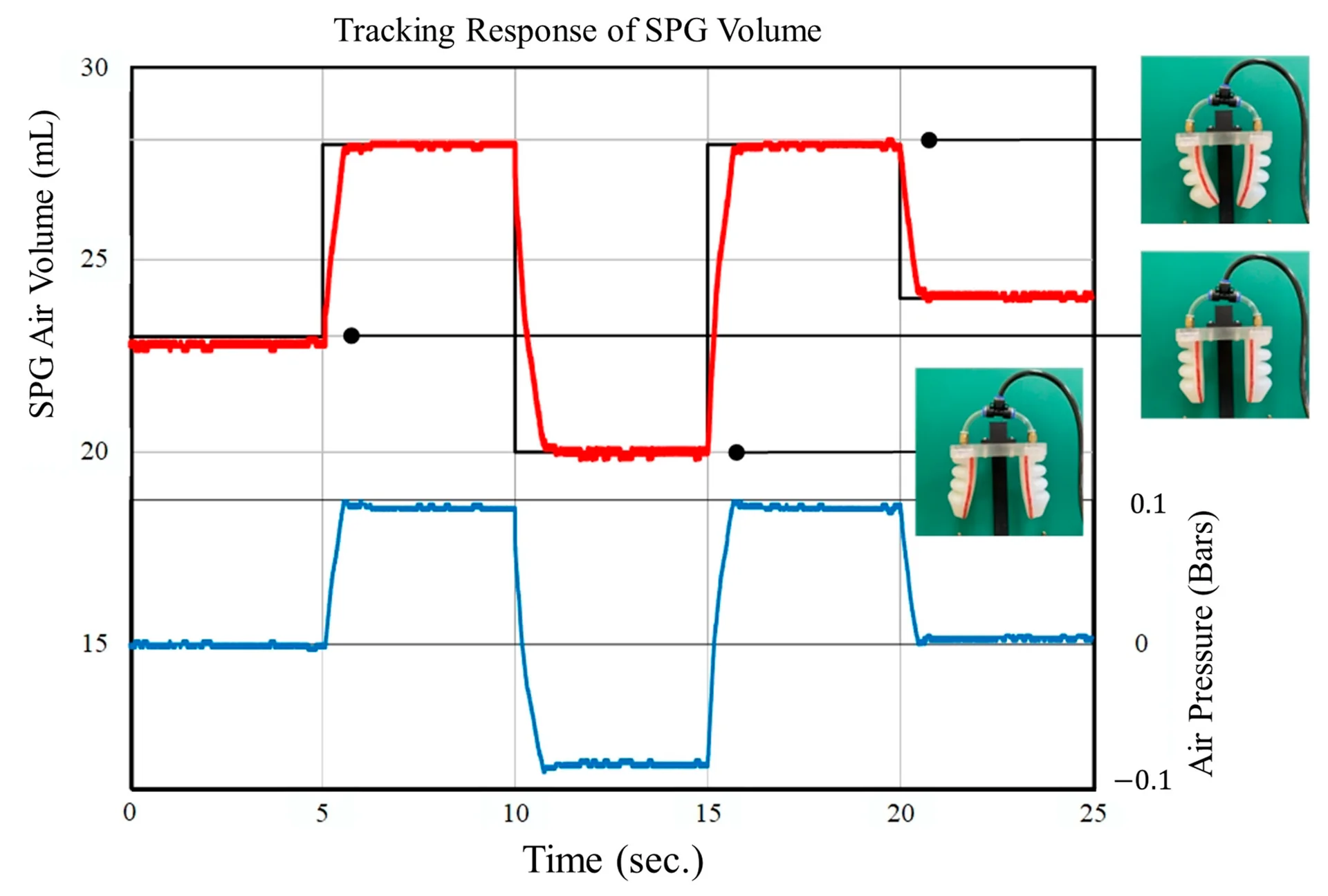
On the software side, a full dynamic model of the electromechanical-pneumatic chain — motor circuit, ball screw, cylinder, and the silicone gripper as a spring-damper system, coupled through Boyle’s law — lets an unknown-input nonlinear observer reconstruct the gripper’s volume from nothing but the motor encoder. A PID loop tuned by Ziegler–Nichols then drives that estimated volume to a commanded grasping profile, in real time at 1 kHz on embedded hardware.
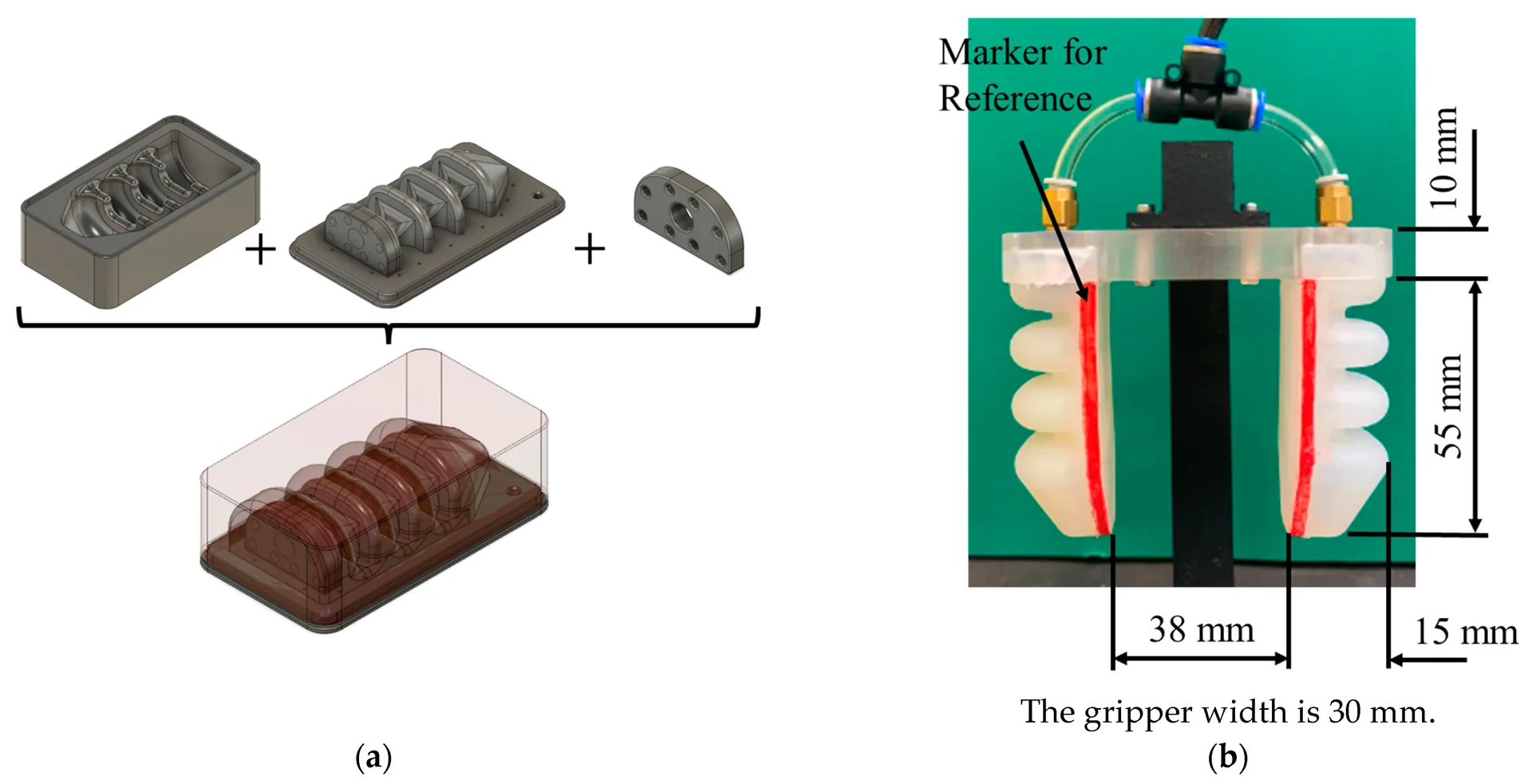
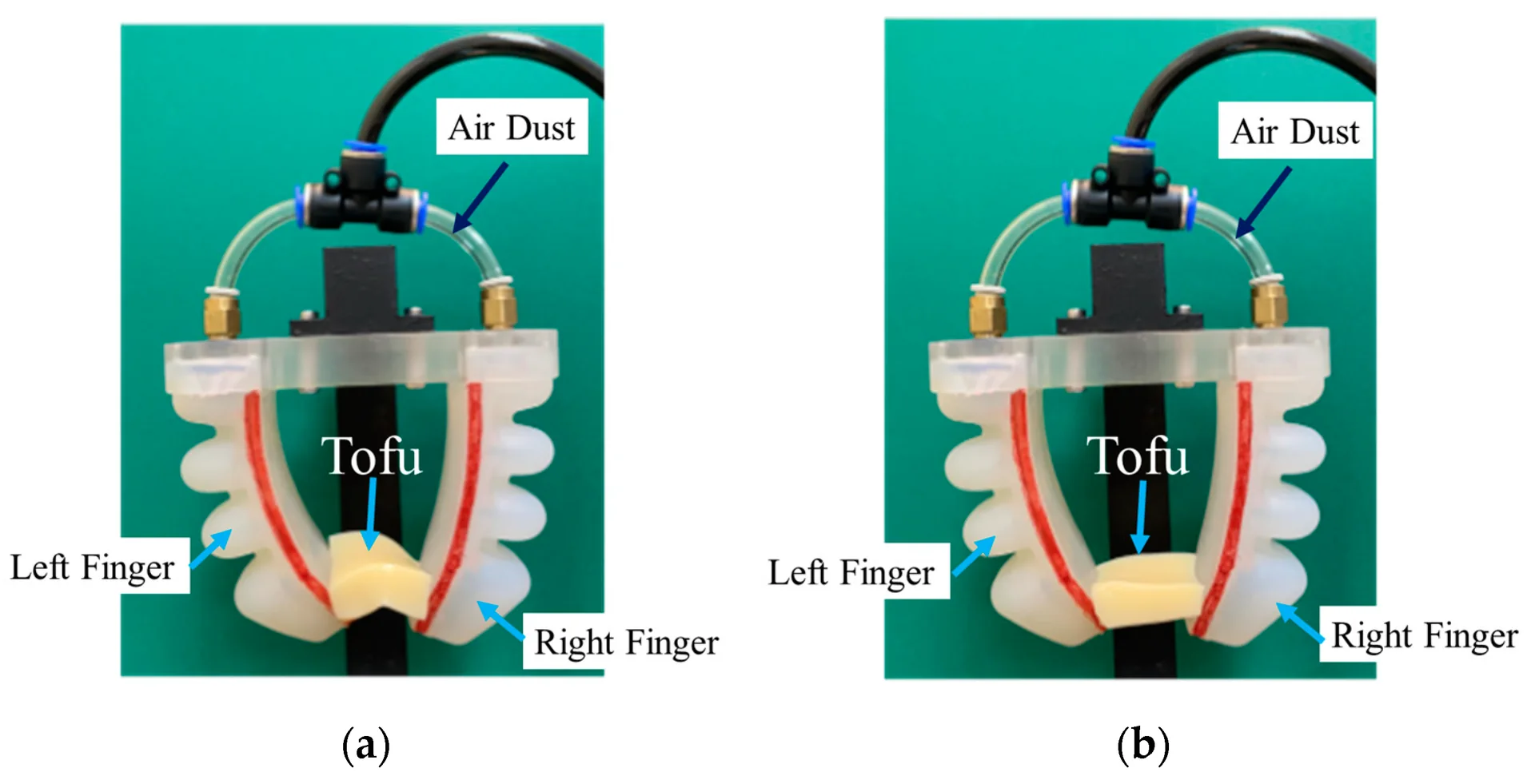
The tofu test: if the gripper can pick up tofu without crushing it, the control works.
Performance
- Real-time control rate
- 1 kHz
- Settling time
- < 1 s
- Overshoot
- 0%
- Volume range
- 20–33 mL
- Sensors on the gripper
- 0
- Published in
- Robotics · MDPI
Outcome
The observer’s volume estimate converged rapidly onto true values across the full working range, proving a physical sensor unnecessary. Volume control achieved sub-second settling with zero overshoot and near-zero steady-state error — the response profile a momentum-free grasp requires. The system demonstrably handles tofu, where conventional on-off control fails outright.
- Chulalongkorn University, Mechanical Engineering
Next case study
10 / 11